
Lucid Waters and Lush Mountains for Beautiful China and World — China's Ecological Civilization Concept and Practice, and How They Inspire the World (Part 2)
Chapter 2 - China’s Practice in Implementing the Concept of “Lucid Waters and Lush Mountains Are Invaluable Assets”

In today’s piece, we are briefing you on the second chapter of our report, “Lucid Waters and Lush Mountains for Beautiful China and World — China’s Ecological Civilization Concept and Practice, and How They Inspire the World.” We would love to answer any questions you might have so be sure to drop a like, comment, and subscribe for more!
The two decades since the proposition of the concept of “lucid waters and lush mountains are invaluable assets” represent a period in which the eco-civilization advancement gradually evolved into a cardinal governance strategy of the Communist Party of China. It was also a period in which China’s eco-environmental quality transitioned from fragmented improvements to progress across the board. Guided by this scientifically grounded concept, China has taken in these two decades ecological conservation as a non-negotiable developmental imperative and worked hard to turn the ecological advantages hidden in its lucid waters and lush mountains into mountains of silver and gold, enabling its sound ecosystems to underpin sustained and healthy socioeconomic development. While creating the dual miracles of rapid economic development and enduring social stability—something rarely seen in the world, China also achieved world-renowned marvels in ecological restoration and green development.
1. Spearheading the Comprehensive Building of a Beautiful China
Since the 18th CPC National Congress, the Party and society as a whole have resolutely embraced and implemented the concept that “lucid waters and lush mountains are invaluable assets”. Eco-civilization advancement has been treated as a fundamental strategy which has a bearing on the sustainable development of the Chinese nation. Through a series of pioneering endeavors, eco-civilization development has undergone historic, transformative, and comprehensive changes, from theory to practice, propelling big strides in the effort to build a Beautiful China.
—Historic changes
Since the 18th CPC National Congress, China has exerted unprecedented effortsto advance eco-civilization, resolving numerous long-standing intractable problems that people had wanted to solve but had remained elusive and accomplishing immense tasks that were unattainable before. The advancement in ecological protection entered a historical phase characterized by the deepest understanding, strongest commitment, most substantive measures, swiftest implementation, and best possible outcomes.
Faced with the people’s growing need for a fine environment, China has prioritized addressing acute ecological challenges through an integrated approach which combines targeted and comprehensive solutions and tackles the root causes as well as symptoms in an effort to win the high-standard battle against pollution. In 2024, in cities at and above the prefectural level, the average concentration of fine particulate matter (PM2.5) was 29.3 μg/m³ and the proportion of surface water cross sections with good quality reached 90.4%, surpassing 90% for the first time. The mainstreams of the Yangtze and Yellow Rivers remained stable in Class II water quality for five and three consecutive years respectively. The good quality ratio of China’s coastal waters reached 83.7%, with 24 typical marine ecosystems removed from the “unhealthy” list. China’s forest coverage exceeded 25% while approximately one-quarter of the world’s new greening areas are contributed by China. The eco-environmental quality has visibly improved, and blue skies, crystalline waters, green shores and river banks, resonant birdsongs, clear seas, flower fragrances and silver sands, have returned to people’s daily lives.
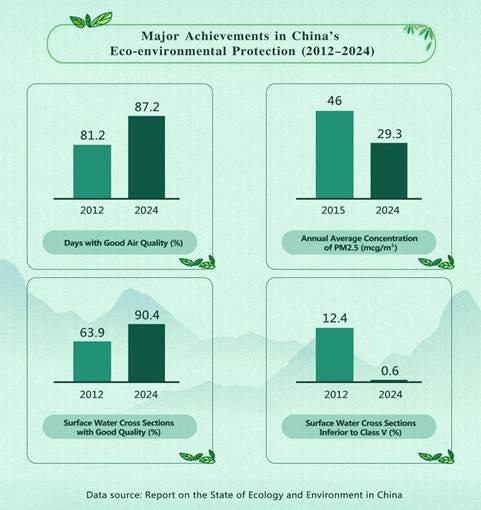
Figure 1: Major Achievements in China’s Eco-environmental Protection (2012–2024)
—Transformative Changes
Faced with the challenge of harmonizing development and conservation, China radically changed its governance paradigm—shifting from conventional development approaches to “ecological prioritization and green development”, and from a reactive environmental governance model aptly described as (“treating the head for headaches and the feet for foot pains”) to one led by the comprehensive green transition of economic and social development. This entailed resolute readjustments and optimization of the industrial and energy mix as well as the transportation structure while actively cultivating and developing green productivity to resolve eco-environmental problems at the root. China upholds green development as a profound revolution in developmental philosophy, having reduced carbon emission intensity cumulatively by over 35% since 2012. Through intensified pollution prevention and control campaigns, we have focused on reversing the trend of ecological degradation. By 2020, the zero solid waste imports target was achieved on schedule, conclusively ending the history when developed countries treated China as a “garbage dumping ground”. By formulating and implementing the Central Environmental Protection Inspection System, China has brought about a major shift in ecological governance from “sectoral responsibility” to “joint Party-government accountability”. Public eco-consciousness has undergone a systematic change. The concept that “lucid waters and lush mountains are invaluable assets” (or “green is gold”) has become societal consensus and action, resulting in a noticeable increase within the entire Party and nation in their initiative and proactiveness to advance eco-environmental improvement. China’s ecological improvement endeavor has undergone profound changes in both theory and practice. It has not only built a solid green foundation and fine quality for Chinese modernization, but also secured the strategic initiative for building a Beautiful China.
—Holistic changes
China embarked on a systematic governance pathway in its eco-environmental development endeavor by exerting efforts across the ideological, legal, institutional, organizational, and working style dimensions and by comprehensively deploying economic, political, legal, market-based, cultural and other means to beef up ecological conservation through an all-dimensional, territory-wide, and whole-process approach. The all-dimensional approach means that it has changed the previous single-element and single-domain governance. It has coordinated industrial structure adjustment, pollution control, ecological protection, and climate change response, and jointly promoted carbon reduction, pollution reduction, green development, and economic growth. It has also comprehensively and systematically carried out integrated protection and systematic governance of mountains, rivers, forests, farmlands, lakes, grasslands, and deserts.
A territory-wide approach is designed to overcome the hitherto fragmentation such as regional disparities, river basin differentiation, and urban-rural dualism in an effort to pursue comprehensive Beautiful China development, build pilot zones for Beautiful China, and promote the development of beautiful cities, villages, rivers, lakes, bays, and more. This gigantic undertaking spans all geographical spaces—urban, rural, terrestrial, marine, plateaus, and wetlands, etc.—forging a unified governance architecture from mountaintops to deep oceans.
With a whole-process approach, we have abandoned the end-of-pipe treatment mentality of the past by persisting in embedding the green concept throughout the whole life cycle of socioeconomic development. This involves building an eco-environmental protection system featuring source prevention, process control, damage compensation, and accountability mechanisms to ensure that eco-environmental requirements are applied through the entire chain, from planning, construction, and production to consumption, waste disposal, and remediation.
2. High-level protection underpins high-quality development
The core of the “green is gold” concept lies in proper handling of the relationship between development and protection, and in supporting quality development with high-level protection. As China transitions into the high-quality development stage, the supporting role of the ecological environment has become increasingly prominent. Green and low-carbon high-quality development based on ecology prioritization can only be achieved through high-level protection. In its modernization drive, China has consistently adhered to the “green is gold” concept, standing firm in properly handling the dialectical unity relationship between high-quality development and high-level protection. By accelerating the optimized readjustment of the industrial mix, promoting comprehensive and green socio-economy transformation, continuously increasing the share of green and low-carbon industries in the total economic volume, and facilitating the formation of green production and lifestyles, China has found a path of quality development characterized by prioritized ecological conservation, resource efficiency, intensive utilization, and green, low-carbon growth.
—Advancing in-depth green and low-carbon transformation
Since 2012, China’s annual economic growth has averaged over 6.1%, supported by an average annual increase of 3.3% in energy consumption. In the first four years of the 14th Five-Year Plan period, energy consumption per unit of GDP decreased by 11.6% in total, equivalent to a reduction of 1.1 billion tons of carbon dioxide emissions, which is close to 50% of the total carbon emissions of the European Union in 2024. Intensified efforts have been made to optimize and readjust the industrial mix with the construction of the world’s largest clean power system and clean steel production system. A full-process ultra-low emission transformation or key project transformation program has been completed, accounting for a total of 930 million tons or approximately 80% of the country’s total crude steel production capacity. China’s comprehensive energy consumption per unit product in sectors such as steel, electrolytic aluminum, cement clinker, and flat glass has reached a world-leading level.
The world’s largest carbon emission rights trading market covering greenhouse gases has been established and has been operating steadily. The national voluntary greenhouse gas emission reduction trading market has been opened. Both projects are contributing to the construction of a paid-use and trading system for pollutant discharge rights.
Energy transformation has been accelerated. As of 2024, the share of non-fossil energy in China’s total energy consumption had risen to 19.7% while the proportion of coal consumption in total energy consumption had dropped to 53.2%. China has built the world’s largest and fastest-growing renewable energy system. By the end of May 2025, the installed capacity of renewable energy power generation reached 2.09 billion kilowatts, more than doubling that by the end of the 13th Five-Year Plan period, with one out of every three kilowatt-hours of electricity in the country being green.
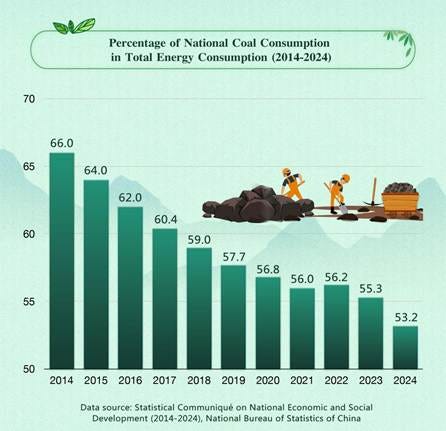
Figure 2: Percentage of National Coal Consumption in Total Energy Consumption (2014-2024)
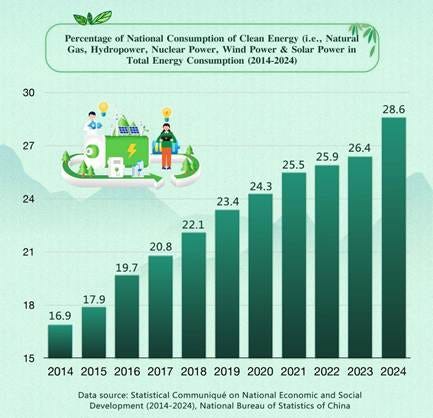
Figure 3: Percentage of National Consumption of Clean Energy (i.e., Natural Gas, Hydropower, Nuclear Power, Wind Power & Solar Power in Total Energy Consumption (2014-2024)
—Building national major strategic highlands for green development
Given China’s vast territory and huge population, the remarkably uneven distribution of natural resource endowments across its regions is rarely seen in the world. Coordinating regional development has therefore always been a major challenge. In promoting coordinated regional development, the key lies in addressing the imbalance. In the regard, staying the course in ecological prioritization and green development is a key measure in implementing major regional strategies. Since 2012, China has taken coordinated regional development as a major national development strategy, adhering to the principle of “coordinating all efforts to complete key national undertakings”. It has adopted measures tailored to local conditions and circumstances, implemented dedicated policies by region, and promoted the construction of green development highlands such as the coordinated development of the Beijing-Tianjin-Hebei region, development of the Yangtze River Economic Belt, construction of the Guangdong-Hong Kong-Macao Greater Bay Area, integrated development of the Yangtze River Delta, and ecological protection and high-quality development of the Yellow River Basin. These efforts have given a boost to coordinated regional development and helped accumulate momentum for sustained progress.
In building green development highlands, the core lies in thorough practice of the “green is gold” concept by keeping to ecological prioritization and green development, and promoting the coordinated development and conservation. Over the eleven years of coordinated development of the Beijing-Tianjin-Hebei region, PM2.5 concentration has dropped by more than 60% and the continuous reduction of wetlands has been reversed.
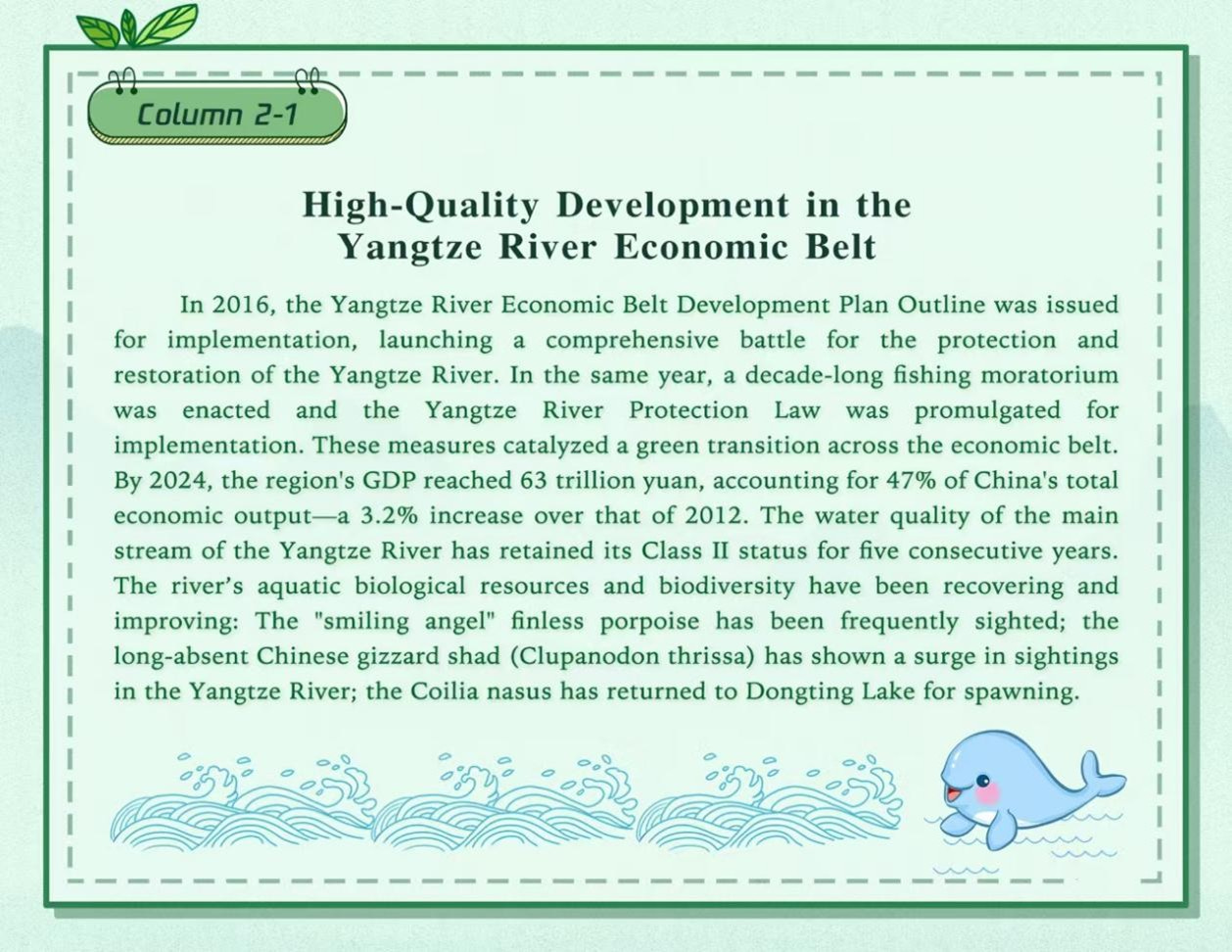
Meanwhile, the total economic output surged past six consecutive trillion-yuan milestones to reach 11.5 trillion yuan in 2024. In the Yangtze River Basin, the percentage of surface water cross sections with excellent quality reached 98.6% in 2024. The water consumption per unit GDP (per 10,000 yuan) in the Yangtze River Economic Belt has declined year by year, with the regional GDP reaching 63 trillion yuan, a year-on-year growth of 5.4%, contributing to a 50.1% share of national economic growth. The ecological quality index of the Yangtze River Delta is higher than the national average while strategic emerging industry clusters in areas such as new energy vehicles, photovoltaics, lithium batteries, and energy conservation and environmental protection are accelerating integrated development.
The Guangdong-Hong Kong-Macao Greater Bay Area is vigorously advancing its construction as a Pilot Zone for Beautiful China, with its regional eco-environmental quality and green development benchmarks leading the nation. Notably, the average PM2.5 concentration of Guangdong reached 20.6 μg/m³ in 2024, consistently outperforming the WHO Phase-2 Interim Target for five consecutive years. The region’s new energy industrial cluster surpassed RMB 1 trillion in revenue, further burnishing the green signature of high-quality development.
—Accelerating the transition toward green lifestyles
A green lifestyle is an important element of high-quality development and an essential part of the practice of the “green is gold” concept. Since the 18th CPC National Congress, China has prioritized fostering green lifestyles, advocated green and low-carbon lifestyles, and promoted the firm establishment of the mindset and habit of thrifty and economical consumption among the general public. The ethos and consumption pattern of simple, moderate, green, low-carbon, civilized, and healthy living have taken root across Chinese. In some cities, the green concept and economic living requirements have been incorporated into social norms such as urban and rural community codes of conduct, student guidelines, and organization charters. The entire people’s public awareness of economic living, environmental protection, and ecological conservation has been effectively strengthened. A social atmosphere of advocating ecological civilization has been taking shape, from saving water and electricity, opposing extravagance and waste, promoting the “Clean Plate” Initiative, establishing tranquil neighborhoods, resisting excessive packaging, and reducing the use of disposable products to prioritizing green travel methods such as public transportation, walking, and cycling.
Consumption of green products has been expanding. In 2024, the ownership of new energy vehicles in China reached 31.4 million, increasing by more than five times the 4.92 million at the end of the 13th Five-Year Plan period. The share of new energy buses has increased from less than 20% ten years ago to over 80% in 2024. A tiered pricing system for residential water, electricity, and gas use has been established, and subsidy policies for the consumption of green and energy-efficient home appliances have been implemented to encourage and guide the public to practice green consumption. The certification and labeling system for green products has been refined. The supplying capacity of green products and services has been enhanced. Over 20,000 green product certification papers and more than 400,000 environmental and energy management system certificates have been issued, ranking first in the world in terms of the number of certificates issued. New modes of green consumption are encouraged to promote the orderly development of the sharing economy.
3. Promoting diversified conversion of ecological values
Over the past 20 years, all regions across China have made unswervingly efforts to protect lucid waters and lush mountains. They have accelerated the establishment and improvement of an ecological economic system centered on eco-industrialization and industry-aided ecological conservation. By continuing to create new drivers and advantages for development through high-level environmental protection, they have explored and formed different conversion paths, i.e., “protecting green in exchange for gold”, “aggregating green to create gold”, and “leveraging green to generate gold”, thus developing a series of distinctive, replicable, and promotable practical experience and development models.
—“Protecting green in exchange for gold”
“Protecting green for gold” refers to a development path that converts the advantages of ecological resources into economic benefits through such mechanisms as protecting the ecological environment, maintaining ecological functions, and leveraging ecological compensation. Focused on the principle that “guarding and increasing greenery means creating wealth”, this model is premised on ecological protection and restoration and directly provides economic returns through government-led ecological compensation, transfer payments, policy incentives, and other means, thus realizing the conversion of “lucid waters and lush mountains” into “invaluable assets”.
Early on, China had started exploring ecological protection compensation. Through mechanisms such as vertical fiscal compensation, inter-regional horizontal compensation, and market-based compensation, it established an incentive system to compensate entities and individuals that carry out ecological protection measures in accordance with regulations or agreements. The central fiscal compensation scheme has continued to expand. From 2013 to 2023, the transfer payment funds for key ecological function zones increased from 42.3 billion yuan to 109.1 billion yuan, with a cumulative input of 790 billion yuan. The funds for water pollution prevention and control rose from 12.2 billion yuan for 2015 to 26.7 billion yuan for 2024.
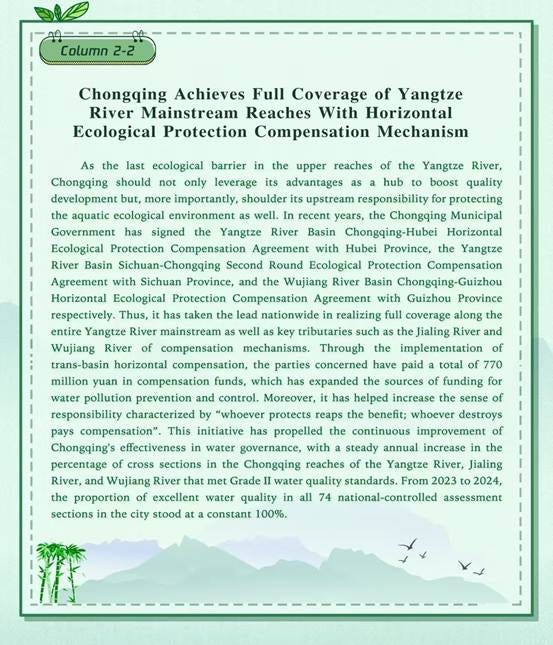
Among these mechanisms, inter-regional horizontal compensation refers to the establishment of an ecological protection compensation mechanism by the people’s governments of an ecological beneficiary region and an ecological protection region through means such as consultation for the purpose of compensation for inter-regional horizontal ecological protection. Now, more than 20 provinces across the country have signed trans-provincial river basin horizontal ecological protection compensation agreements, covering multiple trans-provincial river reaches (or sections), including those of the Yangtze River and the Yellow River. By 2027, a unified horizontal ecological protection compensation mechanism for the main streams of the Yangtze River and the Yellow River will have been established. All regions will have essentially set up trans-regional river basin horizontal ecological protection compensation mechanisms covering key rivers within their jurisdictions. The construction of horizontal ecological protection compensation mechanisms for major inter-basin water diversion projects is moving ahead steadily. Useful explorations will have been made on such mechanisms for ecological elements such as forests, grasslands, the atmosphere, wetlands, deserts, oceans, water flows, and cultivated land.
—“Aggregating green to create gold”
By “aggregating green to create gold” is meant the pathway to spur economic development by fully leveraging ecological advantages to develop eco-agriculture, eco-tourism, eco-industry, or an eco-plus model that synergizes primary, secondary, and tertiary sectors. This model has its emphasis on “developing green industries generates wealth”. It is designed to establish a sustainable eco-economic paradigm through technological innovation, brand building, and industrial chain extension to amplify ecological resource advantages and propel the transition of these ecological resources from “potential value” to “realized economic gains”. Regions with a strong ecological foundation and developed industries with distinct features may want to give top priority to eco-plus sectors and build eco-brands, turning ecological advantages into high-quality development assets. Examples include developing eco-agricultural and forestry products in the eco-farming and eco-livestock/poultry rearing arena and creating green brands through deep processing to achieve value-added premiums. The cultural meaning behind ecological resources should be tapped through the organic integration of natural landscapes with cultural elements—regional history, folk traditions and customs, artistic expressions, etc.—to produce culturally distinctive creative products and industries.
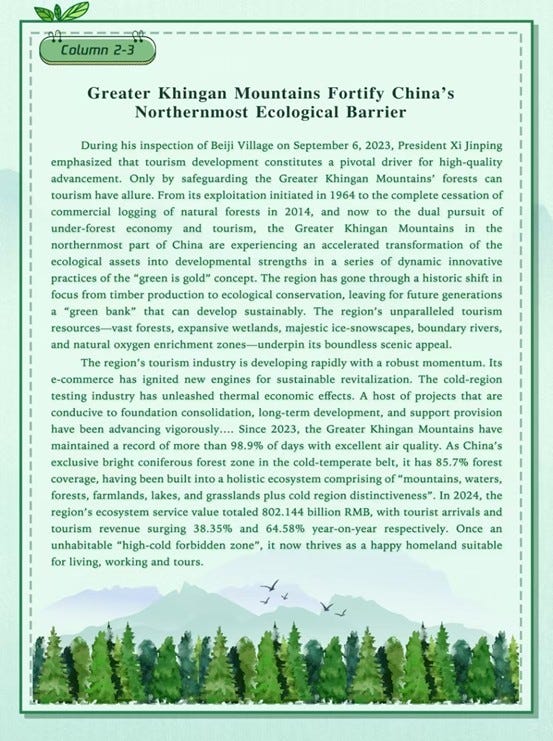
Developing eco-tourism and wellness tourism industries—transforming pristine natural environments into resources for tourism, vacations, and health preservation—constitutes an important approach to “activating green into gold”. By 2024, China’s tourist attractions received 6.76 billion annual visits with total revenue reaching 481.42 billion RMB. The nation boasts 78,000 certified green, organic, geographically featured, and premium specialty agricultural products alongside 1,597 major rural tourism villages and towns. Among them, 15 villages, including Yucun Village of Zhejiang Province, Xidi Village of Anhui Province, and Jingzhu Village of Chongqing Municipality, have been designated “Best Tourism Villages” by the United Nations World Tourism Organization, securing top position for China in the world.
—“Leveraging green to generate gold”
“Leveraging green to generate gold” refers to a pathway for converting ecological advantages into measurable and tradable assets or services through the improvement of the market transaction system for ecological products and the green finance system, using market-based mechanisms. This model is based on emphasizing “developing green markets and green finance as an equivalent to creating wealth”. Through policy guidance, technological support, and financial innovation, it is designed to promote the participation of ecological resources in market circulation, forming a conversion chain of “resources–assets–capital” and ultimately achieving a win-win for both ecological conservation and economic benefits. In regions of China with good ecological endowments, abundant natural resources, and fairly strong institutional innovation capabilities, China supports high-quality development with economic growth in sound interaction with environmental protection by establishing green capital markets and developing green finance. These include issuing green bonds, providing green credit, establishing green development funds, and attracting private investment into ecological conservation and green industry projects. By now, China has built a multi-tiered system of green financial products and markets. It leads the world in both green credit and green bond issuance. As of the end of 2024, China’s outstanding balance of domestic and foreign currency green loans stood at RMB 36.6 trillion and its total green bond issuance exceeded RMB 4.1 trillion.
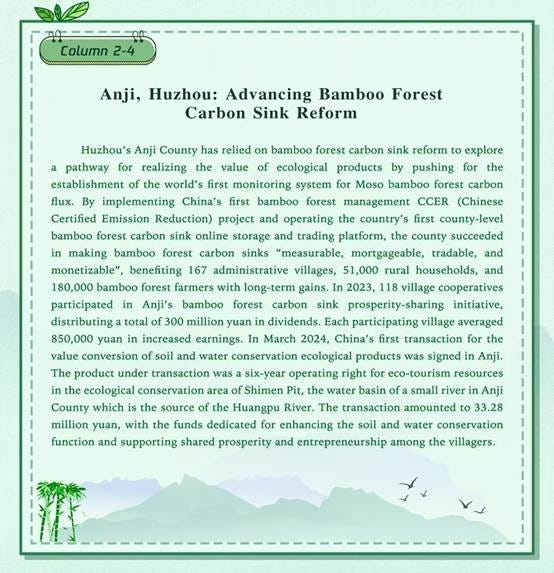
China is also exploring the development of rights-based markets for trading in forest ownership, water rights, and carbon sinks, further expanding the pathways for conversion from lucid waters and lush mountains to invaluable assets. Issued in 2024, Opinions on Leveraging Green Finance to Support the Building of a Beautiful China proposes enhancing green financial products and services, developing new forms and models of green finance, and making the value of nature more tangible and accessible.
Chapter 3: To be Continued…
It is common knowledge that the waters that feed the farmland in China are all polluted, in turn polluting the farm products.
It would be wonderful if this pollution could be cleaned up and health returned to the populace as well as making Chinese food exports safe and attractive to customers around the world.
So-called "anthropogenic global warming"---allegedly due to the world's non-oligarch-class people generating too much carbon dioxide (along with methane from bovine flatus) which act as "greenhouse gasses" that trap solar heat---has been revealed to be unfounded by actual data and based on unproven assumptions (the oligarch class obviously exempts itself, as the live in fabulous energy-consuming luxury and travel the world in exhaust-spewing private jets and yachts). In fact, the increased percentage of CO2 in the atmosphere has led to increased greening of the planet, as plant life depends on it.
The real problem of modern life is environmental pollution, but the oligarchs seldom mention it, as it is generally due to their own corporate policies, which seek to increase profits by "externalizing" any and all responsibility and expense for cleaning up the water, air, and land they use to manufacture the products they sell at huge profits. (This has also been expressed in terms of the"tragedy of the commons".) So the oligarchs ignore the true, health-damaging problems of modern life because otherwise they would have to assume responsibility (=cost) for remedying them, and instead try to blame the rest of mankind for the fabricated horrors of increasing CO2 emissions as a way to incite a feeling of guilt and force acceptance of draconian behavioral restrictions (to the extent of encouraging population reduction, and in the case of Bill Gates & his ilk, instead forcing population reduction through promotion of deadly vaccines, environmentally harmful "geoengineering", introduction of poisonous mRNA technology into the food chain, etc. etc.).